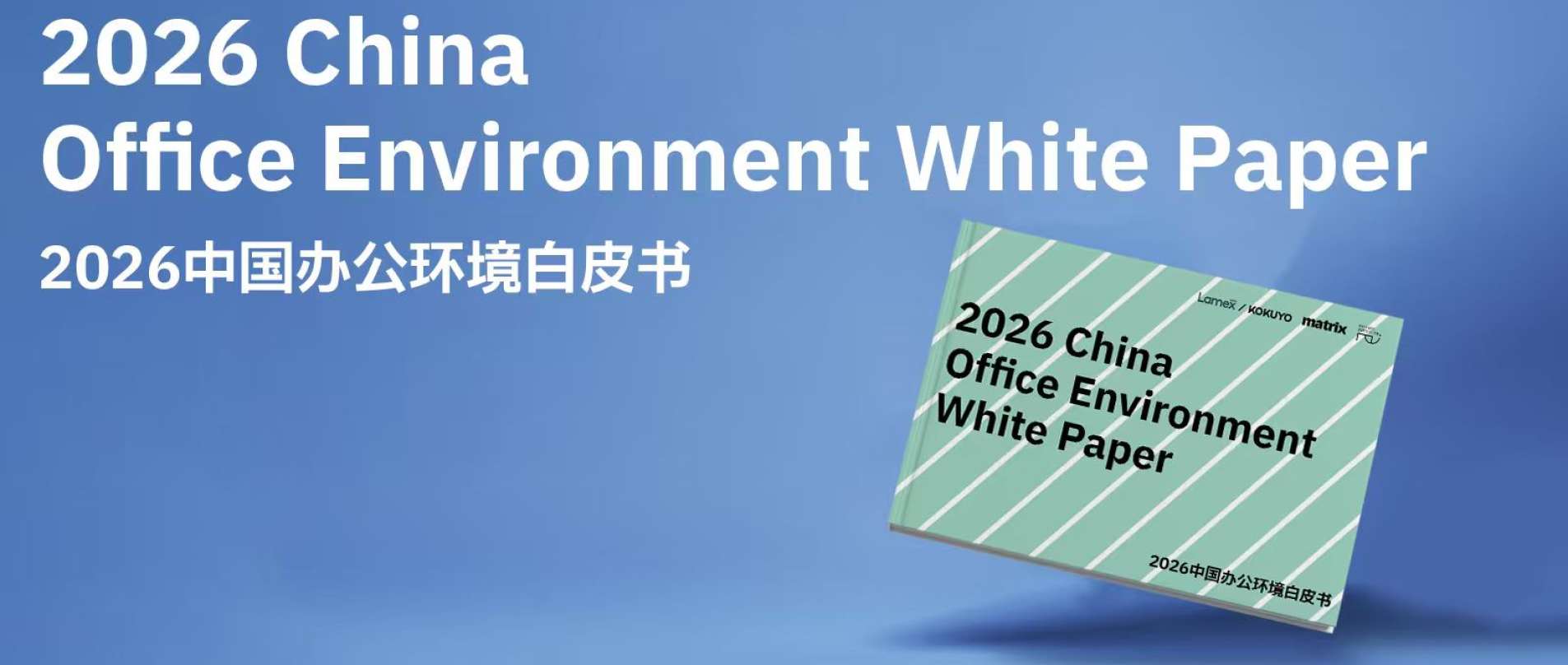
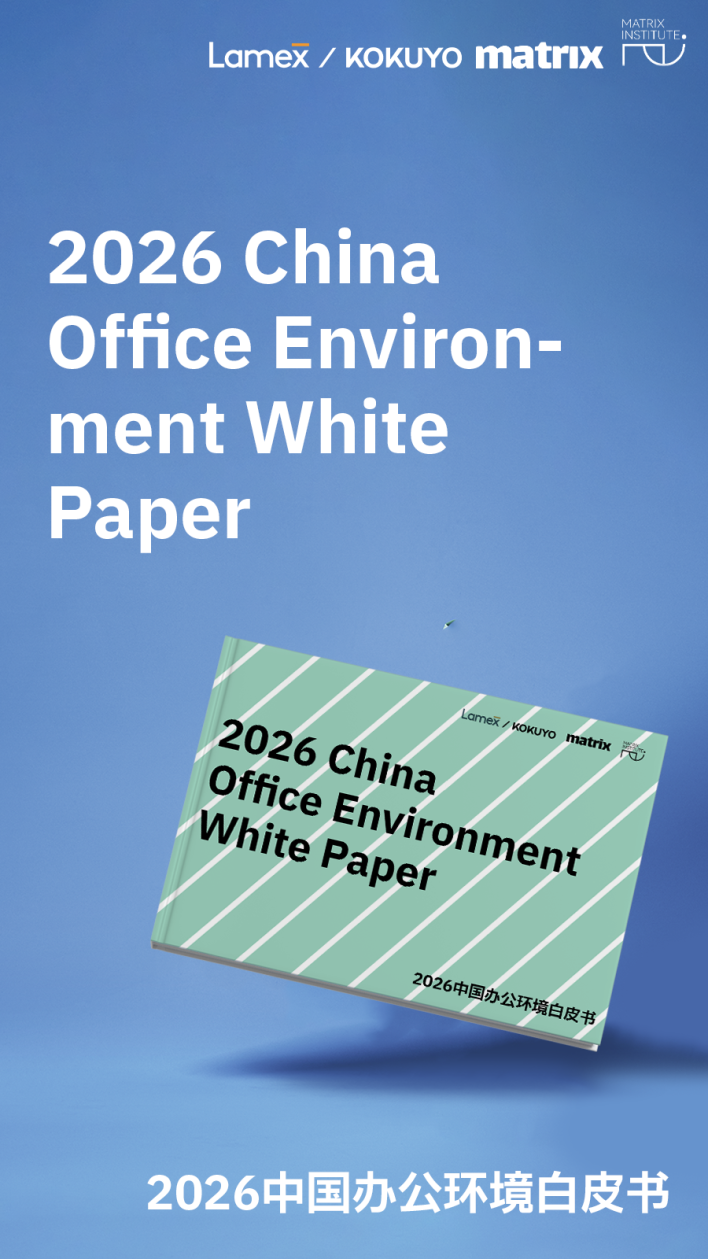
During the 57th China International Furniture Fair (Guangzhou), KOKUYO Furniture and Lamex Furniture officially released the 2026 China Office Environment White Paper.
The white paper was jointly researched by KOKUYO Furniture, Matrix Design, and Matrix Research Institute, co-initiated with the Shenzhen Furniture Industry Association, and supported by Cushman & Wakefield with professional consultation. The report aims to provide an in-depth analysis of the paradigm shift taking place in China’s office environment and to offer forward-looking guidance for the innovative upgrading of corporate workplaces.
I. Key Finding: A Fundamental Shift from “Space Logic” to “Capability Logic”
The white paper points out that office space in China is undergoing a profound transformation at the level of its underlying logic. This shift can be summarized as follows:
Old logic: the physical stacking of workstations and square footage.
New logic: a transition toward “capability building,” centered on collaboration efficiency, professional work, employee vitality, external relationships, and sustainable operations.
This means that the office has moved beyond being merely a physical container. It is evolving into a critical carrier of organizational efficiency, brand expression, and emotional connection, becoming an increasingly important lever for companies navigating a mature, stock-driven era.
II. Theoretical Framework: Introducing the Original “6+1” Model to Decode the Future Workplace Experience
Based on a deep review of Chinese corporate culture and future workplace trends, the white paper originally proposes a forward-looking theoretical framework called “6 Experiences & 1 Mode.” This framework breaks away from conventional, one-size-fits-all office layout thinking and instead turns to micro-level insights into people and collaboration.
1. Six Key Experiences
The research identifies six key experiences that drive organizational evolution:
2. One Core Mode
The white paper also introduces “deep focus” as the core mode and central spirit of the overall framework.
Through the recombination of diverse scenarios and the precise coordination of functional modules, this model redefines how office space can provide certainty and support for both organizational collaboration and individual creativity in a fast-moving business environment.
III. Trend Outlook and Industry Validation: Office Space as an “Efficiency Asset”
The white paper presents a clear outlook on workplace trends for 2026, identifying quality and efficiency enhancement as the core narrative driving spatial evolution. The normalization of hybrid work and the continued rise in the proportion of external-facing communication spaces both confirm the strong influence of business needs on spatial design.
This research is deeply grounded in five major future-oriented industries: artificial intelligence, healthcare, new energy, advanced manufacturing, and great consumption. Through empirical study of the differentiated needs of these industries, the report develops trend insights and actionable strategies across three dimensions: office space design, office furniture, and office CMF (Color, Material, Finish). This ensures that its trend judgments are not only visionary but also practically applicable.
It also signals that office space is rapidly shifting from being a cost center to becoming an efficiency asset. Rather than serving only as a place to house work, it is evolving into essential infrastructure that supports organizational collaboration, brand expression, and business growth.
IV. Significance of the Release: Exploring How the Workplace Can Become a “Value Engine” for Business
KOKUYO and Lamex have invested significant time and effort into this research because of one simple yet firm belief: the essence of office furniture is not merely to sell desks and chairs, but to serve the way people work and the way organizations evolve.
While much of the industry still focuses primarily on product functionality and price competition, KOKUYO and Lamex have chosen to move one step further, studying how people behave in space, how different industries work, and how these insights can be translated into more forward-looking spatial solutions.
This white paper represents a concrete step from manufacturing toward research-driven service, and a further deepening of the principle of human-centered design.
Through this white paper, KOKUYO and Lamex hope to explore a core question together with industry peers:
As growth logic and organizational models are being rapidly restructured, how can the office environment evolve from a passively used space into a true value engine for business development?
In the future, the premium value of office space will no longer be determined by scale or fit-out cost, but by whether it can accelerate consensus-building, inspire cross-team collaboration, renew employee wellbeing, and create a field of trust that resonates deeply with partners.
The 2026 China Office Environment White Paper is now available for free download via the following link. More information will be officially released soon through KOKUYO’s official channels. Please stay tuned.